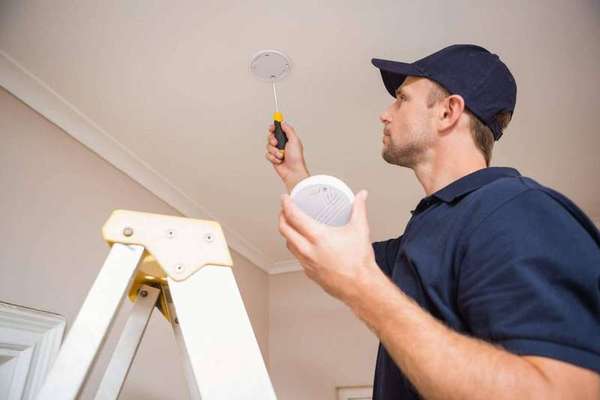
Why Placement Matters as Much as the Device
Most homeowners know they need smoke alarms. Fewer know that national installation guidance calls for alarms inside every bedroom, outside each sleeping area, and on every level of the home, including the basement — with particular attention to keeping detectors away from kitchens and bathrooms where steam and cooking routinely cause nuisance alarms. A licensed electrician places each unit where smoke will reach it quickly and where daily life won’t train your family to ignore it.
Placement also affects how we wire the job. Hardwired, interconnected alarms need routing between ceiling boxes — something we plan on a walkthrough so coverage follows the layout of your home rather than whatever was easiest for the original builder.
Hardwired & Interconnected vs. Battery-Only
Hardwired with battery backup
Connected to your home’s electrical system with a battery backup for outages. Units are interconnected: when one senses smoke, every alarm in the home sounds together, so a fire in the garage wakes someone sleeping two floors away. This is the standard we recommend for new installs and full replacements.
Battery-only
A good fit where running new wire is impractical, or as a supplement to a hardwired system. These rely entirely on the battery — no power, no protection. We install them where appropriate and recommend wireless-interconnected models when we do, so you still get whole-home alerting.
Many Port St. Lucie homes built in past decades have a mix: aging hardwired units near the original bedrooms and nothing protecting a later addition. We audit the whole home and fill the gaps so coverage is complete and consistent.
When Aging Units Need to Go
Smoke alarms wear out. The sensing chamber degrades over time, and national guidance (NFPA 72) recommends replacing smoke alarms 10 years after their manufacture date — not the install date. If your detectors are yellowed, have a manufacture date you can’t read anymore, or chirp even with fresh batteries, they are telling you their service life is over.
- Check the back of each unit for its manufacture date; older than 10 years means replace.
- Frequent false alarms or a chirp that new batteries don’t fix are end-of-life symptoms.
- Replacing all units at once keeps sensing technology consistent and gives every alarm the same fresh 10-year clock.
Combination Smoke & Carbon Monoxide Alarms
Florida homes with gas appliances, attached garages, or fireplaces have a second silent risk: carbon monoxide. We install combination smoke/CO units where it makes sense — near sleeping areas and on each level — so one device watches for both threats. If you already have smoke coverage and only need CO protection, we can add dedicated CO alarms at the right locations rather than replacing working smoke units.
Serving the Treasure Coast
We install and replace smoke detectors throughout Port St. Lucie and the surrounding communities — from the 1970s and 80s neighborhoods where original hardwired systems are past their prime, to newer developments where owners want wireless interconnection added to an existing layout.
- Port St. Lucie
- Fort Pierce
- Stuart
- Jensen Beach
- Palm City
Learn More
Find placement guidance for every room and level of your homeon our smoke detector installation page.
Request an Estimate
Tell us about your home and we’ll put together an estimate for new installation or full replacement of your smoke detection system.
Smoke Detector Installation FAQs
How many smoke detectors does my home need?
As a general rule: one inside every bedroom, one outside each sleeping area (hallways), and one on every level including the basement. Large homes and split floor plans may need more to keep coverage consistent. We map it out on the walkthrough.
What’s the difference between hardwired and battery smoke detectors?
Hardwired units draw power from your home’s electrical system (with battery backup for outages) and are typically interconnected so all alarms sound together. Battery-only units are simpler to install but depend entirely on the battery and don’t alert the rest of the house unless they have wireless interconnection.
How often should smoke detectors be replaced?
National guidance (NFPA 72) recommends replacement 10 years after the manufacture date printed on the unit. Sensors degrade over time, and batteries can’t fix a worn-out sensing chamber.
Why does my smoke detector keep chirping?
A steady chirp usually means a low battery. If new batteries don’t stop it, the unit may be at end-of-life or have dust buildup in the sensing chamber. We can diagnose and replace the unit during a service visit.
Do I need carbon monoxide detectors too?
If your home has gas appliances, an attached garage, or a fireplace, CO protection is strongly recommended near sleeping areas. We can install combination smoke/CO alarms or standalone CO detectors, whichever fits your existing setup.
Can you install detectors in a home that never had hardwired ones?
Yes. Where running new wiring is practical we’ll hardwire interconnected units; where it isn’t, we install wireless-interconnected battery alarms that still give you whole-home alerting without opening walls.
Do you install smoke detectors in rental properties?
Yes. We work with landlords and property managers to bring rentals up to consistent, documented coverage — useful both for tenant safety and for your own records.
Will you install detectors I already purchased?
Yes. If you’ve bought units from a store, we’ll install them for you and check compatibility with any existing interconnected system before we start.